
"There are three kinds of lies: lies, damned lies, and statistics."
Often attributed to Mark Twain, although its true origin remains uncertain.
The problem isn't the metric. It's the question you're trying to answer.
Every executive has sat through the meeting. The dashboard is on the screen. Revenue is up. Customer Satisfaction (CSAT) is holding steady. Net Promoter Score (NPS) dipped two points. Someone asks whether that's a problem, and the room begins debating the numbers.
Unfortunately, they're debating the wrong thing. One of the biggest mistakes organizations make is treating customer metrics as universal indicators of business performance. Executives often ask which metric is better, as if one score can measure every aspect of an organization. It can't. The better question is this: What business decision are you trying to make?
Metrics Exist to Support Decisions
One of the first lessons of good management is that every metric should support a decision. A metric without a purpose is simply another number on a dashboard.
Too often, organizations collect customer feedback without defining what they're trying to learn. They review scores every month, celebrate improvements, or worry about declines without asking whether they're measuring the right thing. The result is predictable: leaders begin making operational decisions with strategic metrics, or strategic decisions with operational metrics.
The problem isn't statistics. The problem is asking the wrong questions, measuring the wrong things, or drawing the wrong conclusions from the data.
“Looking back, I don't believe the organization had a people problem. I believe it had a measurement problem.”
A Lesson I Learned
Early in my career, I worked for a large organization that measured individual performance using Net Promoter Score. Leadership wanted accountability, and on paper NPS seemed like a reasonable way to measure customer experience.
Over time, however, it became a performance management tool for individual contributors. Eventually, it was weaponized against those delivering the work, even though many of the factors influencing a customer's score had nothing to do with their performance. Pricing, product limitations, executive decisions, project scope, contracts, and customer expectations all influenced the score. Yet the consultant, project manager, trainer, or support engineer sitting across the table from the client was often the one held accountable.
That experience changed the way I think about performance measurement. What would have helped us improve wasn't another NPS report. It would have been a simple CSAT survey, or even a smiley face or frowny face with one question: "What could we have done better?" That would have produced feedback we could actually act on.
"Sometimes the loudest voice in your survey has the smallest influence on your next contract."
The Disconnect Most Customers Don't Know Exists
Most survey respondents have no idea how NPS is scored. To most people, an 8 out of 10 is a good score. A 7 means, "The service was pretty good, but there is room for improvement." That isn't how NPS works.
Only 9s and 10s count as Promoters. Scores of 7 and 8 are Passives and contribute nothing to the score. Scores from 0 through 6 are Detractors. That creates a serious disconnect: the customer thinks, "They did a good job," while leadership sees, "We have a loyalty problem."
There is another disconnect that is rarely discussed. The person completing the survey may not be the decision maker. In many organizations, surveys are completed by end users or individual contributors who have little influence over vendor selection, contract renewals, or future purchasing decisions.
Their feedback absolutely matters because it reveals operational strengths and weaknesses. However, it may not reflect customer loyalty or whether the organization intends to continue doing business with you. That doesn't make NPS a bad metric. It means leaders need to understand both what the metric measures and who is answering the question.
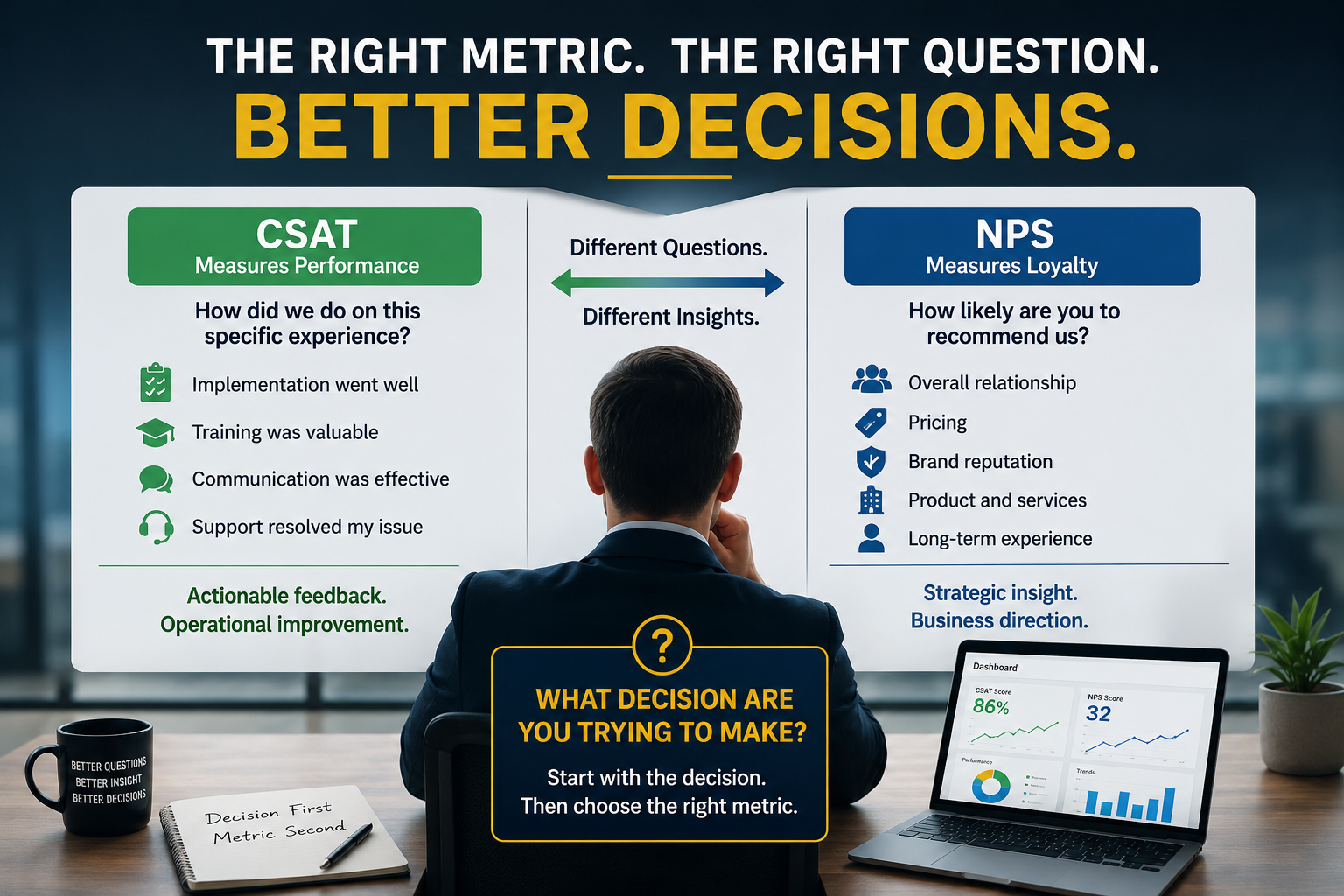
CSAT Measures Execution. NPS Measures Loyalty.
CSAT answers operational questions: Did the implementation go well? Was the training valuable? Did the consultant communicate effectively? Was the support issue resolved professionally? These are areas individual contributors can influence directly. More importantly, low CSAT scores provide actionable feedback that helps people improve.
NPS answers a different question: Would you recommend this company to someone else? That response reflects the customer's overall relationship with your organization. Pricing, brand reputation, product quality, executive relationships, and long-term experience all influence the answer. Those are strategic considerations, not individual performance measures.
The Wrong Metric Leads to the Wrong Conclusions
Imagine a project manager delivers an outstanding implementation. The project finishes on schedule, stays within budget, communication is excellent, and training receives glowing reviews. Then the client learns that next year's licensing costs are increasing.
When asked whether they would recommend the company, they hesitate. Did the project manager suddenly become less effective? Of course not. The organization simply asked a question that measured something entirely different.
"Better businesses aren't built on better dashboards. They're built on better thinking."
Better Questions Create Better Organizations
Organizations often search for one metric that summarizes everything. Business doesn't work that way. Different decisions require different measurements. If you're evaluating a training course, CSAT is probably the better choice. If you're evaluating customer loyalty, NPS becomes far more meaningful. If you're evaluating employee performance, neither metric should stand alone.
The most valuable lesson I've learned isn't about CSAT or NPS. It's that every measurement exists to support a decision. When leaders begin by asking, "What decision are we trying to improve?", the right metric usually becomes obvious.
At Cedar Rock Consulting, we believe organizations don't improve because they collect more data. They improve because they ask better questions, choose metrics that align with those questions, and use the results to make better decisions. Because better businesses aren't built on better dashboards. They're built on better thinking.
Author Bio
Ron Smith, MBA, is the Founder and Owner of Cedar Rock Consulting, where he helps organizations improve business performance through strategy, process optimization, project management, and technology adoption.