
Several years ago, an firm brought me in to help them find better ways to collaborate with owners, GCs and trades on a project. Communication was flowing well during design and construction. Then the building was finished, and the client was furious. Equipment they believed they had asked to include was missing, and in their mind the project manager had simply failed to deliver what was promised.
The PM pushed back. He was certain the client had actually said the opposite. What followed came close to a lawsuit, months of accusation and defense with no way to prove either side right. The dispute was only resolved when the PM found an old handwritten note buried in his desk from a meeting held early in the project. It confirmed, in the client's own words, that the equipment in question should not be included. The lawsuit was avoided, but only because one piece of paper happened to survive in a drawer. It never should have come down to luck.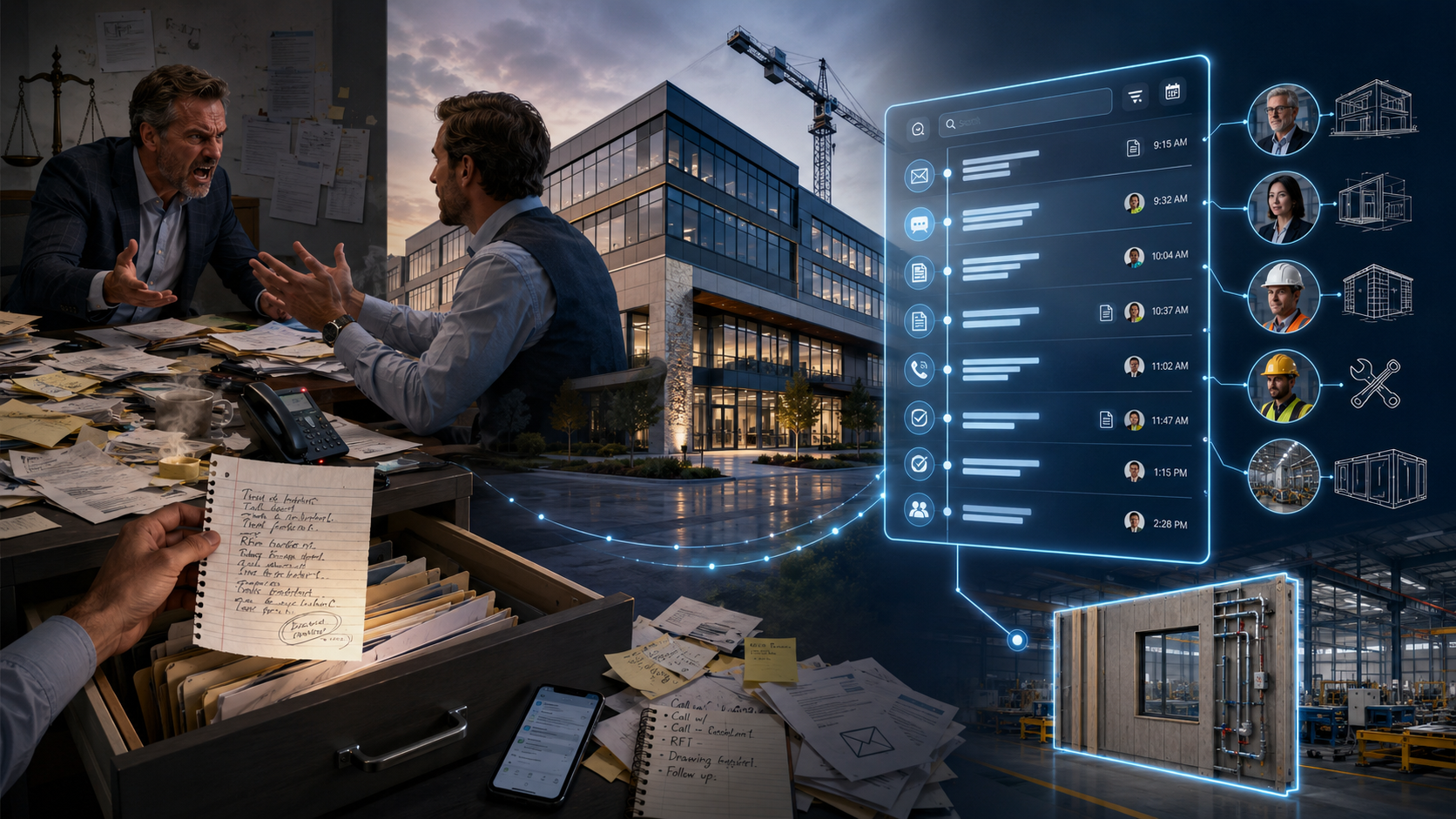
This scenario plays out on projects everywhere. Construction generates an overwhelming volume of communication. Emails, letters, phone call notes, field memos and meeting confirmations all carry legal and financial weight, yet most of it still lives in personal inboxes, scattered folders or handwritten notes that only one person can find, if it survives at all.
Why Correspondence Gets Lost in the Shuffle
Unlike RFIs or submittals, correspondence often has no formal system behind it. An RFI has a number. A submittal has a review cycle. Correspondence is just communication, and communication tends to flow through whatever channel is fastest at the moment, whether that is a verbal conversation in a meeting, a personal email account or a quick note nobody thinks to file properly.
The result is a project record full of holes. When a dispute arises months or years later, teams scramble to reconstruct a timeline from memory, inboxes and desk drawers. Insurance claims stall. Change order negotiations drag on. Trust between owner, architect and contractor erodes, not because anyone acted in bad faith, but because nobody could prove what was actually said and when.
Why This Matters Even More in Industrialized Construction
Industrialized construction, where components are manufactured offsite and assembled onsite, runs on tighter margins for error than traditional building. A factory building a wall panel or a mechanical module cannot pause production the way a site crew might pause a task while waiting for clarification. Once a panel is built to a specification, reversing that decision means scrapping material and losing schedule, not just erasing a line on paper.
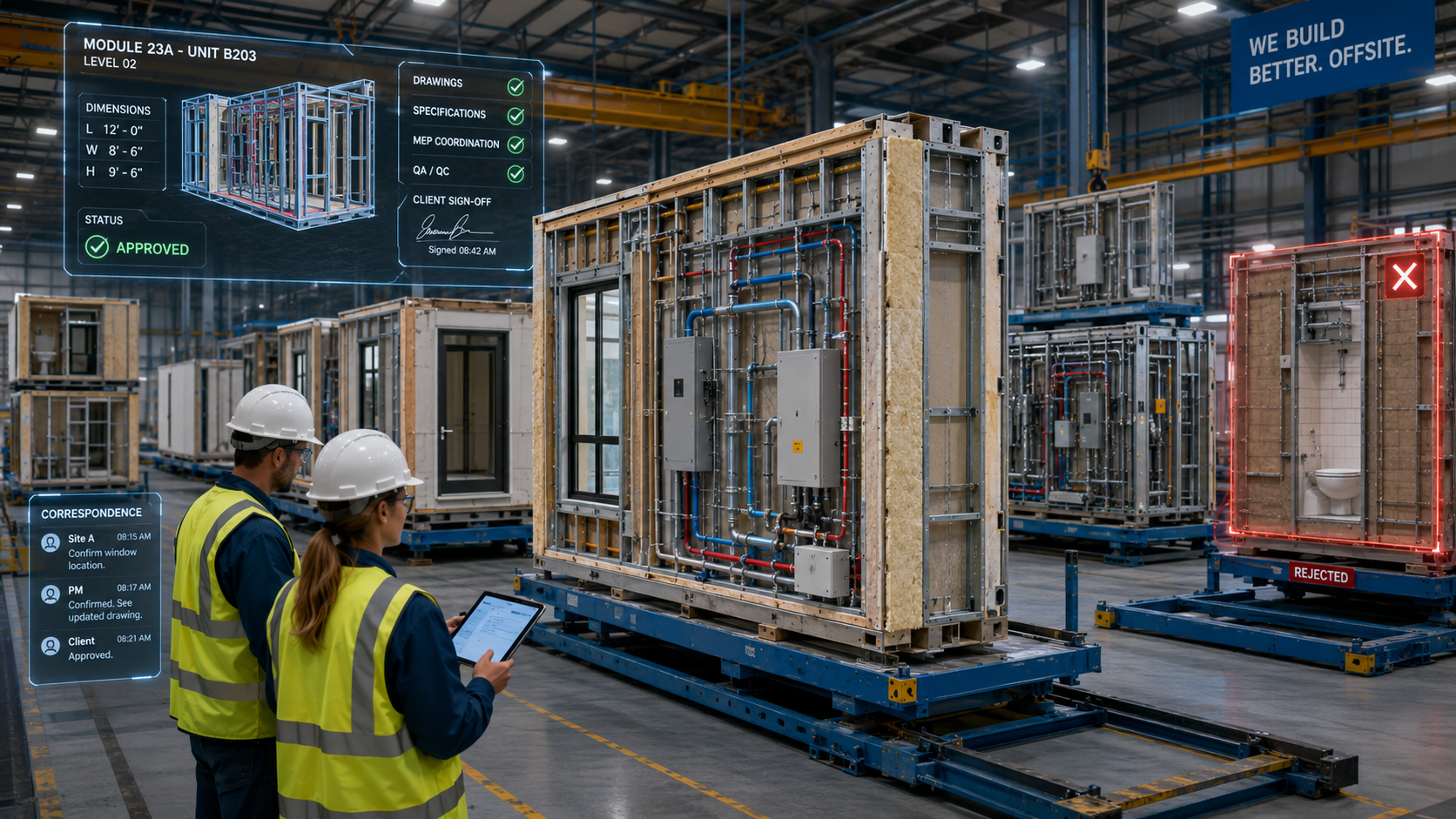
That means every correspondence decision, a confirmed dimension, an approved equipment list, a client sign off, has to reach the factory floor accurately and on time. A verbal agreement that never gets logged does not just risk a future dispute the way it might on a conventional job. It risks a factory building the wrong thing before anyone notices the gap. The equipment left out of the building in this story would have been far more costly to fix if it had already been manufactured into a module rather than simply omitted from a punch list.
Manufacturing industries solved this problem decades ago by treating every specification change as a documented, traceable event tied to the production record. Construction is only now catching up, and industrialized construction is where the gap shows up fastest.
The Real Cost Is Not Just Time
Lost correspondence is expensive in ways that rarely show up on a budget line. Legal teams charge by the hour to reconstruct timelines from email exports and handwritten notes. Disputes that could have been settled with a single forwarded message instead turn into near litigation. Even when a lawsuit is avoided, as it was in this case, the cost in stress, strained relationships and wasted months is real.
There is also a trust cost. Owners and architects want to work with teams who can produce a clear record on demand. A firm that cannot quickly answer "when did we tell you about this" looks disorganized even when the underlying work is excellent.
What a Connected System Changes
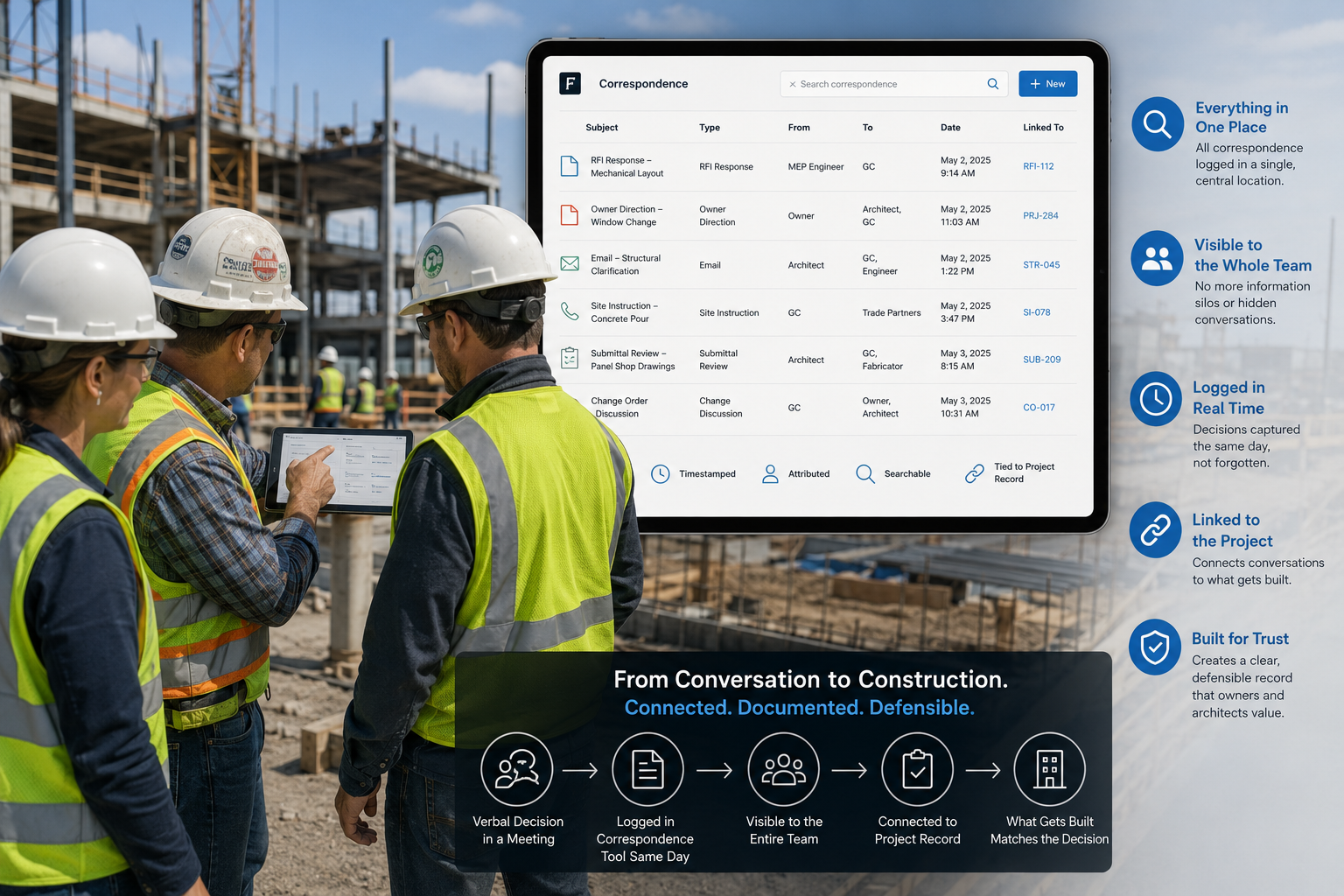
Centralized correspondence tools built into modern project management platforms solve this by giving every piece of communication a home the whole team can search. Autodesk Forma Build's Correspondence tool logs letters, emails and notices in one place, tied to the project record rather than to any one person's inbox or desk drawer. Every entry is timestamped, attributed and searchable, so a dispute that once took months to untangle becomes a search that takes seconds.
This matters most in the moments nobody plans for. A verbal decision made in a meeting gets logged the same day, not scribbled on paper and forgotten. A scope change discussed with a client is visible to the whole team, not held in one person's memory. For teams working in industrialized construction, that same log becomes the link between a client conversation and what actually gets built in the factory, closing the exact gap that nearly caused a lawsuit in this story.
Good correspondence tracking does not just protect against disputes. It builds the kind of transparent, well documented project history that owners and architects notice and remember when the next contract comes up for bid.
Knowing this did not guarantee the firm changed course. The BIM Manager held significant influence over technology decisions and dismissed the idea of adopting a system built to solve exactly this problem. As of the time I left that firm, no such system had been put in place. The near lawsuit had been survived, but the underlying gap that caused it was still there, waiting for the next dispute that might not end with a lucky note in a drawer.
Cedar Rock Consulting works with construction teams to close these communication gaps, whether that means adopting connected tools like Autodesk Forma Build or simply building better habits around how project information gets captured and shared.